Exact match in Google Ads no longer guarantees that your brand keywords will only trigger ads for the searches you intended. Close variants, AI Max expansion, and AI-powered search experiences have changed how brand ads are matched and prioritized, making it harder to control where brand budgets go. Protecting that spend requires understanding each matching mechanism, monitoring search term drift, and using Google's keyword prioritization rules and campaign controls to keep valuable brand demand in the right campaigns.
What Can an Exact Match Brand Keyword Match Today?
Exact match brand keywords in Google Ads can trigger ads for close variants with the same meaning or intent. AI Max can expand matching beyond those keywords, while AI Mode introduces another search experience where exact match ads can appear. Each works differently and requires different controls.
Close Variants: Exact Match Is Not Literal Match
Google Ads automatically matches exact keywords to variations with the same meaning or intent. These include misspellings, singulars and plurals, abbreviations, reordered words, implied words, synonyms, and other wording changes.
If an appliance brand called Northstar uses the exact match keyword [northstar refrigerators], Google could potentially match that keyword to a search like "northstar fridge" because the meaning is essentially the same. The search terms report labels this Exact match (close variant).
But a search such as "northstar refrigerator reviews" introduces research intent that may convert differently from a direct product search.
A brand campaign built to capture people already looking for the company can start picking up adjacent intent that converts differently.
Exact match still provides more control than broad match, but it does not guarantee that every dollar stays focused on the brand demand the campaign was designed to capture.
Google does not offer an opt-out. Even with AI Max disabled, close variants remain active.
AI Max: Expansion Beyond Close Variants
AI Max search term matching uses broad match and keywordless technology to reach searches beyond the original keyword's normal matching behavior.
For example, a brand called Acme Shoes with an exact match keyword [acme shoes] could trigger an ad for a broader search like "comfortable walking shoes" if AI Max determines that the search is relevant to the products on Acme's landing page. The search doesn't mention Acme, and it isn't necessarily a close variant of the brand keyword.
In the search terms report, AI Max traffic appears under the AI Max match type. The Source column distinguishes expansion from an existing keyword versus keywordless matching based on signals like landing pages.
Brand campaigns typically capture existing demand, while non-brand campaigns are expected to generate new demand. When AI Max starts matching a brand campaign to broader category searches, that boundary can break down.
The campaign may still report conversions, but those results no longer tell a clean story about brand demand. That makes it harder to evaluate acquisition costs, allocate budget between brand and non-brand, and know whether automation is actually improving performance.
AI Max search term matching can be turned off at the ad group level, while ordinary close variants remain active. Search term matching also doesn't work with manual CPC bidding, so a brand campaign on manual CPC won't expand through AI Max.
AI Mode: A Different Search Experience
Exact and phrase match keywords can also serve ads in Google's AI Mode when searches show direct commercial intent.
On September 4, 2026, Google's Ads Liaison Ginny Marvin confirmed a small experiment allowing exact and phrase match keywords to serve text ads in AI Mode for searches with explicit, direct intent.
Google's current documentation on ads in AI-powered Search experiences now confirms that eligibility, while distinguishing direct query matching from the broader contextual matching available through AI Max and other automated targeting.
There is a reporting catch. For Lens, AI Mode, AI Overviews, and autocomplete, Google says reported search terms may approximate user intent rather than reproduce an exact query. As a result, the usual identical-keyword prioritization rule may not apply.
Even when a brand keyword is eligible, advertisers have less visibility into the exact search behavior that triggered the ad or why one ad group received priority over another. The search terms report alone may not explain a change in brand traffic.
Teams managing brand and non-brand separately risk losing confidence in where demand is being captured and which campaigns deserve credit for it.
AI Mode is not another close variant setting, and Google does not provide a separate AI Mode advertising opt-out.
How the Three Mechanisms Compare
Close variants, AI Max, and AI Mode differ in what they match, how they appear in reporting, and how much control advertisers have over them.
|
Mechanism |
What It Matches |
Reporting |
Control |
|---|---|---|---|
|
Close variants |
Same-meaning searches and wording variations |
Exact match (close variant) |
No opt-out |
|
AI Max |
Broader and keywordless search matching |
AI Max match type and Source column |
Ad group setting |
|
AI Mode |
Direct-intent searches in AI-powered results |
Standard reporting; no dedicated AI Mode split |
Existing campaign controls |
Before changing keywords or campaign settings, determine whether unexpected traffic comes from close variants, AI Max expansion, or a different search experience. The same fix will not address all three.
How Much Has AI Max Expanded Exact Match Impressions?
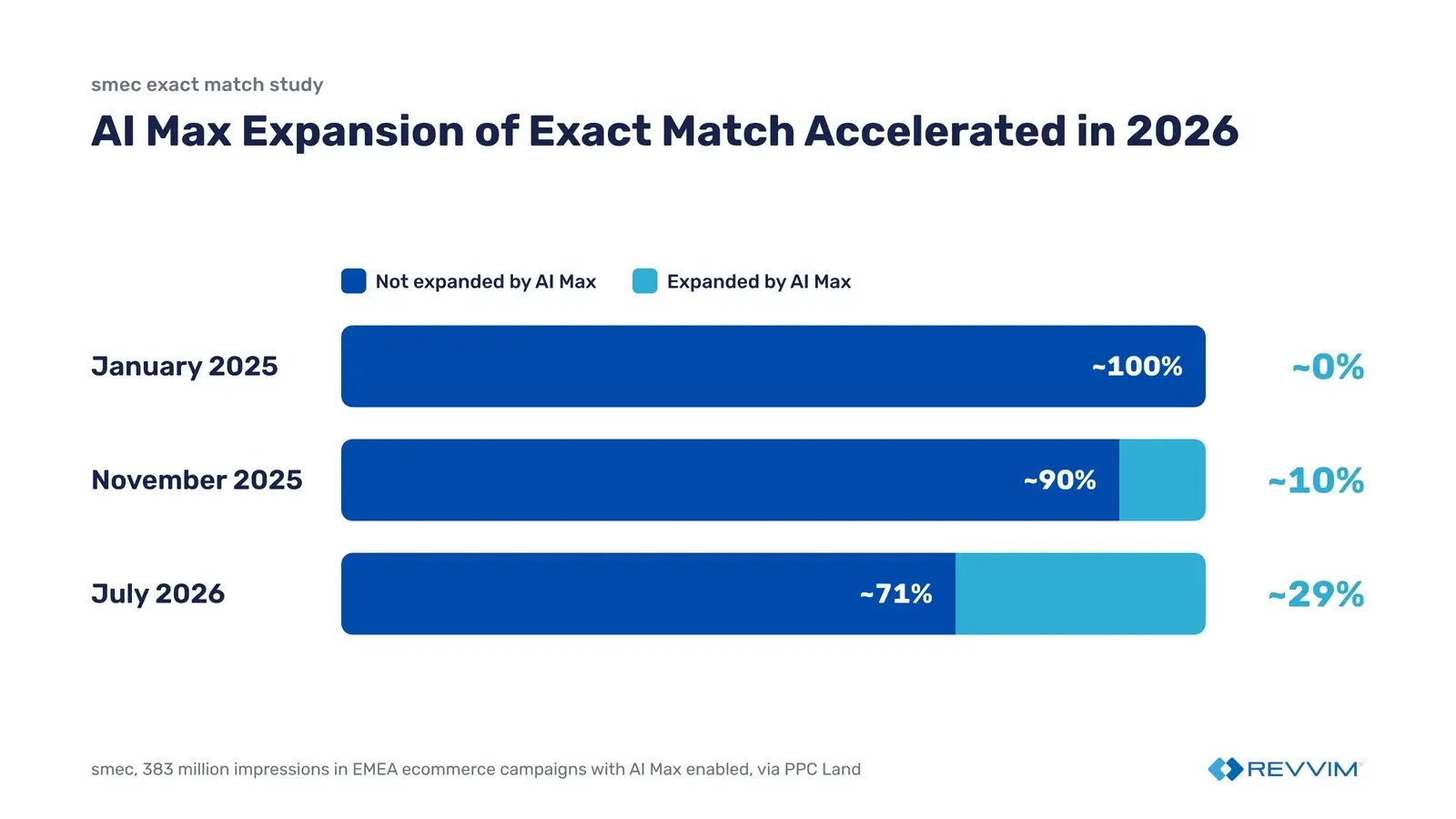
By July 2026, approximately 29% of impressions associated with exact match keywords were generated through AI Max search term matching in a study of ecommerce Search campaigns across Europe, the Middle East, and Africa (EMEA) with AI Max enabled. That share was near zero in early 2025. The finding shows how quickly exact match traffic can expand once AI Max is active, but it does not represent campaigns without AI Max.
Smarter Ecommerce (smec) analyzed 383 million impressions from January 2025 through July 2026. The research found that AI Max was responsible for a growing share of impressions attributed to exact match keywords.
The change was not gradual. According to PPC Land's analysis of smec's chart, expansion reached roughly 10% around November 2025, then accelerated in 2026. About two-thirds of the total increase occurred in the final four months of the study.
|
Period |
Not Expanded by AI Max |
Expanded by AI Max |
|---|---|---|
|
January 2025 |
~100% |
~0% |
|
November 2025 |
~90% |
~10% |
|
July 2026 |
~71% |
~29% |
In a separate sample of one million AI Max impressions published in late 2025, smec found that roughly 80% of AI Max-attributed impressions came from expansion associated with exact match keywords, compared with 20% from phrase match keywords.
The bigger concern for brand advertisers is that a campaign built to capture existing brand demand can begin spending on broader searches without a corresponding change to its keyword list. That makes brand performance harder to interpret and can blur the budget boundary between capturing existing demand and acquiring new customers.
This matters even for advertisers who never manually turned on AI Max.
In September 2026, Google automatically migrated Search campaigns using the old campaign-level broad match setting or automatically created assets to AI Max.
Under AI Max, search term matching is enabled by default, allowing campaigns to reach additional searches through broad match expansion and keywordless technology. For campaigns on the broad match setting, the old setting already broadened keyword matching, so this wasn't necessarily new expansion. Campaigns migrated because of automatically created assets are different. Google's migration notes show they also received search term matching by default, so an exact match brand campaign that only used automatically created assets may now be expanding for the first time.
But it changed the feature and controls governing that traffic. For brand campaign managers, the priority is to check whether AI Max search term matching is active rather than assume their previous settings still apply.
The smec findings do not prove that expanded impressions are unprofitable. They show why brand advertisers can no longer assume an exact match keyword list tells them where their impressions are coming from.
How Do You Measure How Far Your Brand Keywords Have Drifted?
Measure brand keyword drift by separating reported search term impressions into exact matches, close variants, and AI Max expansion. Track the share of impressions coming from each category over time, then identify whether the additional traffic is reaching your own brand, competitors, or non-brand searches.
The starting point is Google's search terms report, where you can measure how much of your brand campaign's traffic comes from close variants and AI Max expansion rather than the exact keywords you originally targeted.
Run a Brand Keyword Drift Audit
A brand keyword drift audit takes six steps in the search terms report and is worth repeating monthly.
- Open the search terms report. In Google Ads, go to Campaigns → Insights and reports → Search terms. Select your brand Search campaigns and the ad groups containing exact match brand keywords.
- Add the reporting columns. Include Search term, Keyword, Match type, Source, Impressions, Cost, and Conversions. If the Keyword column isn't visible, add it under Columns → Attributes.
- Export and separate the matching categories. Identify rows associated with exact match brand keywords. Group the visible impressions into:
- Exact match: Reported searches matching the keyword.
- Exact match (close variant): Searches Google considers equivalent in meaning or intent.
- AI Max: Additional matches attributed to AI Max expansion. Use the Source column to distinguish keyword expansion from keywordless matching.
- Calculate the observed expansion rate. Divide AI Max impressions attributable to exact match brand keywords by the total visible search-term impressions attributable to those same keywords. Calculate the close variant share separately. Exclude keywordless matches that Google doesn't attribute to a specific keyword from this calculation, but track them at the campaign level.
- Classify the additional searches. Group reported queries into your own brand, competitor brands, and non-brand searches. Compare impressions, cost, and conversions to see where the brand budget is going.
- Repeat monthly. Use consistent reporting windows, campaigns, and attribution rules. Watch for increases in non-brand spend or declining conversion quality before making targeting changes.
Example: What the Audit Might Reveal
In this hypothetical audit, 40% of the impressions attributed to one exact match brand keyword came from close variants and AI Max expansion.
Consider a hypothetical home appliance retailer called Northstar Appliances running an AI Max-enabled brand campaign with the exact match keyword [northstar appliances].
After exporting a month's search terms, the team finds:
|
Reported Match Type |
Impressions |
Share |
|---|---|---|
|
Exact match |
6,000 |
60% |
|
Exact match (close variant) |
2,000 |
20% |
|
AI Max expansion |
2,000 |
20% |
|
Total |
10,000 |
100% |
Looking more closely at the 2,000 AI Max impressions, the team finds searches for "best energy efficient refrigerators" and "dishwasher brands comparison." Neither mentions Northstar, but both could be relevant to products on the retailer's website.
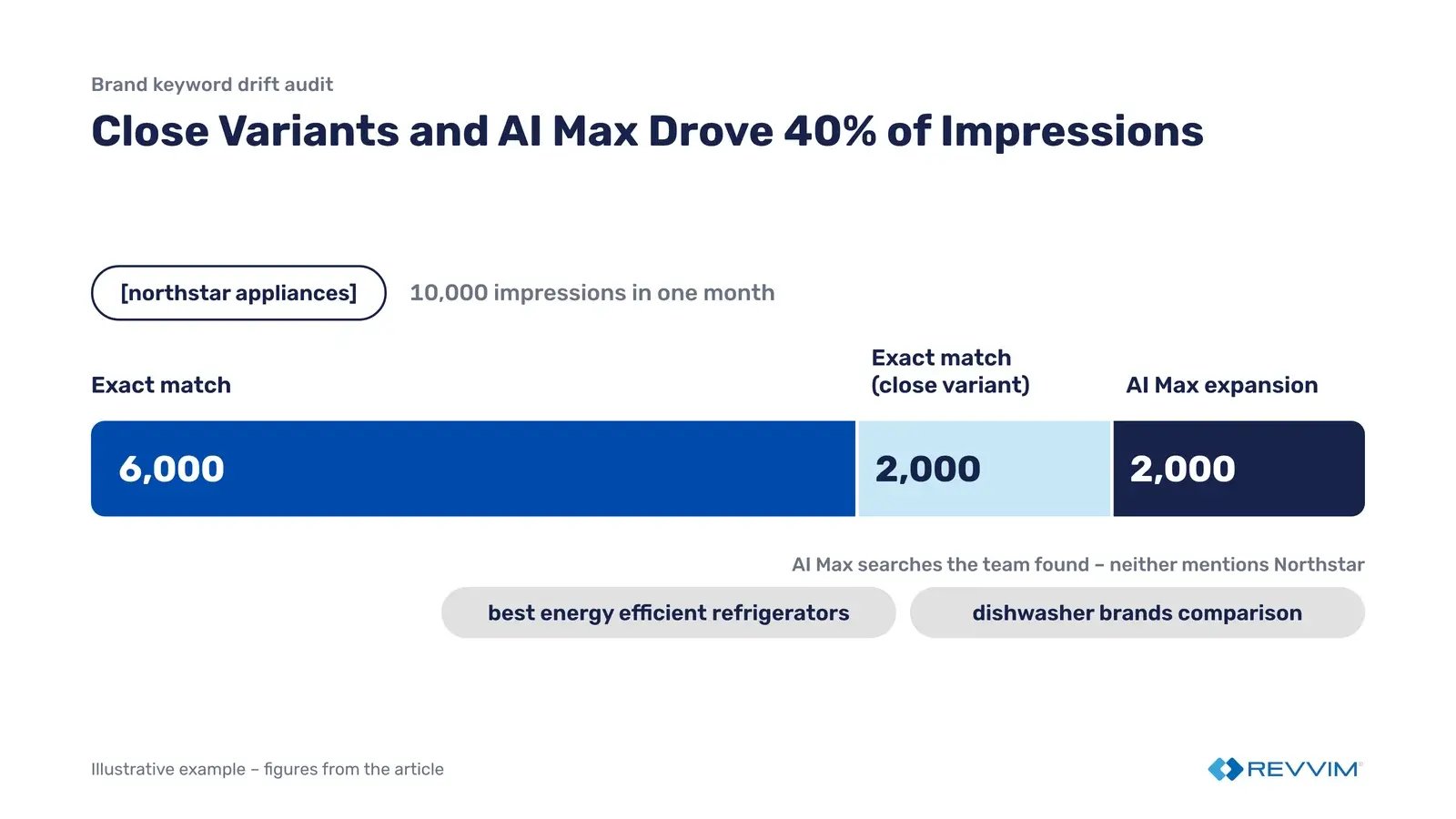
The audit shows that 20% of the visible impressions attributed to the brand keyword came through AI Max expansion, with another 20% coming through close variants. The next question is how much those searches cost and whether they convert at rates that justify spending brand campaign budget on them.
If the broader queries have higher acquisition costs or weaker conversion rates, the team has evidence to reconsider AI Max search term matching in that ad group. If they generate profitable new customers, the traffic may be worth keeping, though separating it from brand demand would make performance easier to evaluate.
What the Report Won't Tell You
Google's search terms report excludes some low-volume queries, and AI Max keywordless matches cannot always be attributed to individual keywords. Filtering for AI Max also excludes the "Other search terms" category.
That means the calculated expansion rate only reflects visible, attributable traffic. It is not a complete account-wide measure or a direct replication of Smarter Ecommerce's research.
Google also warns that reported search terms from Lens, AI Mode, AI Overviews, and autocomplete may approximate user intent rather than reproduce the actual query. An apparently identical search term doesn't always mean Google's normal exact keyword prioritization rules applied.
For marketing leaders, the important finding is how much budget intended to capture existing brand demand is reaching competitor or non-brand searches, and whether that traffic is economically justified. A rising expansion rate deserves investigation, but decisions should be based on spend, conversion quality, customer acquisition costs, and the role the brand campaign is supposed to play.
How Do You Make Exact Match Win Your Brand Queries Again?
Google Ads gives eligible exact match keywords priority when they are identical to someone's search. That helps keep valuable brand searches in the campaigns designed to capture them, even when broad match, AI Max, or Performance Max could also serve an ad.
The same search can qualify for ads from multiple campaigns in your account.
For example, a search for "Northstar Appliances" might qualify for the advertiser's dedicated brand Search campaign, a non-brand Search campaign using broad match, and a Performance Max campaign promoting its products.
Google's keyword prioritization rules determine which eligible keyword or targeting method gets preference. If the brand campaign contains [northstar appliances], that identical exact match keyword generally takes priority over the broader alternatives.
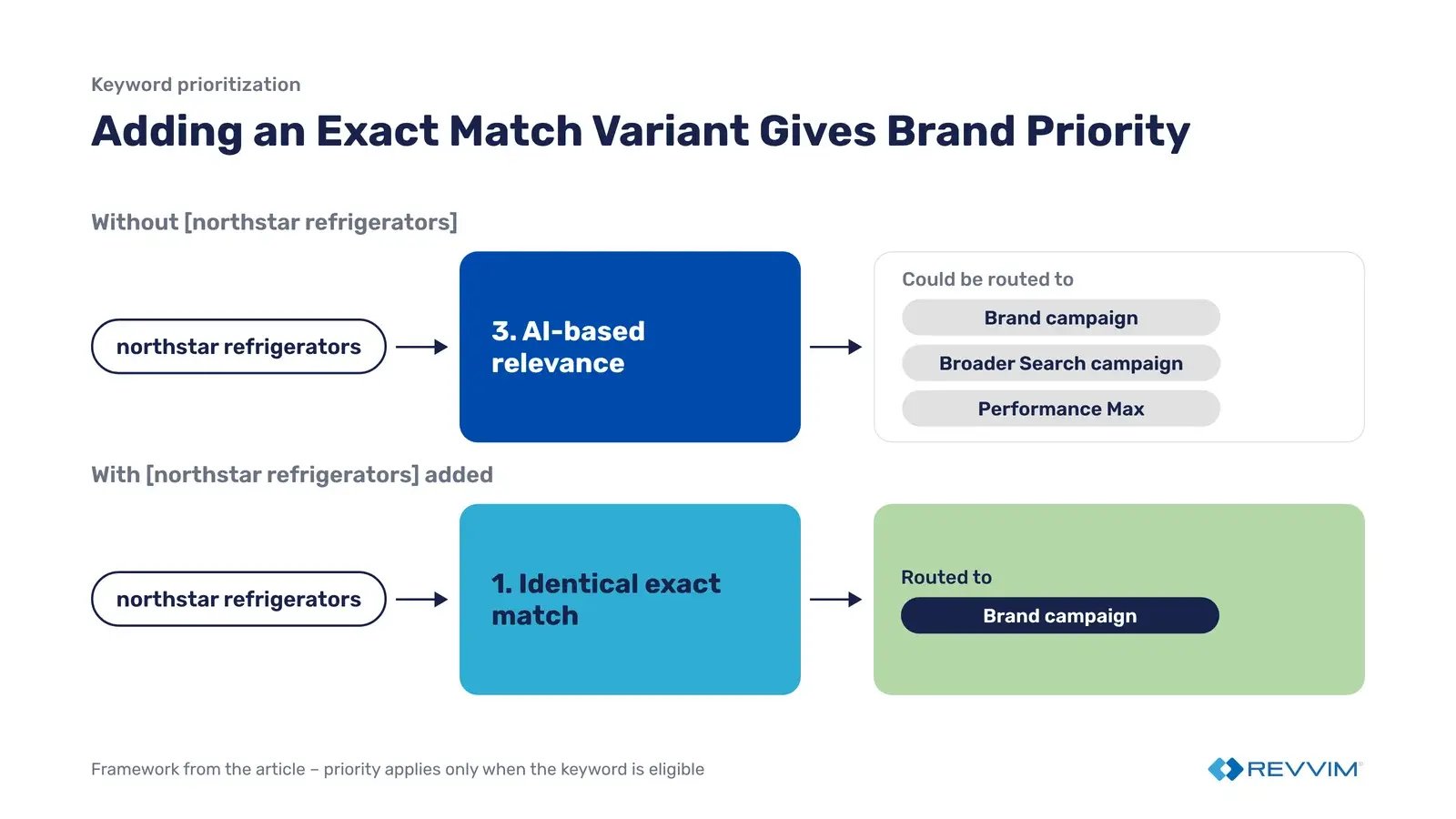
But if someone searches for "Northstar refrigerators" and the account doesn't contain that identical exact match keyword, Google may rely on other eligible keywords or its AI-based relevance systems to decide which ad group or asset group serves.
That's why adding important brand variants as their own exact match keywords can help. It gives Google a stronger reason to route those searches to the intended brand campaign instead of allowing broader automated targeting to compete for them.
|
Priority |
How Google Decides |
What It Means for Northstar |
|---|---|---|
|
1. Identical exact match |
Google first looks for an eligible exact match keyword identical to the search. |
A search for "Northstar Appliances" is prioritized to the brand campaign containing [northstar appliances], ahead of broader targeting. |
|
2. Other identical matches |
If there's no eligible identical exact match, Google prioritizes identical phrase or broad keywords, including AI Max, and Performance Max search themes. |
If the exact keyword is missing or ineligible, "northstar appliances" in another Search campaign or an identical Performance Max search theme can receive priority. |
|
3. AI-based relevance |
If no identical keyword or search theme takes priority, Google evaluates which eligible ad group or asset group is most relevant. |
A search for "Northstar refrigerators" could be routed to the brand campaign, a broader Search campaign, or Performance Max based on relevance. |
|
4. Ad Rank |
When multiple options have equal priority, Google uses Ad Rank to decide which one serves. |
If two eligible ad groups are equally prioritized, the one with the higher Ad Rank gets the opportunity to serve. |
Adding important brand variations as eligible exact match keywords gives Google a clear reason to select the intended brand campaign before relying on broader automated targeting. This preference is not guaranteed when the keyword is ineligible or when Google's advanced search experience exceptions apply.
Put Exact Match Priority to Work
Start with the brand variants identified in the drift audit. Group them into misspellings, singulars and plurals, reordered words, and alternative brand or product names.
Then focus on the variants that represent valuable brand demand:
- Add important variants as exact match keywords. If "northstar refrigerators" consistently drives valuable traffic, adding [northstar refrigerators] gives that search an eligible identical exact match keyword. Avoid adding every spelling variation. Google already accounts for spell correction in its prioritization rules.
- Review AI Max search term matching. In the relevant ad group's settings, find AI Max and disable search term matching if broader expansion doesn't belong in the brand campaign. This does not disable ordinary close variants.
- Apply brand controls where appropriate. Under Campaign settings → AI Max → Brands, brand inclusions can restrict matching to searches related to specified brands. Google supports inclusions at the campaign and ad group levels, while brand exclusions operate at the campaign level. Ad group inclusions override campaign-level inclusions for that ad group. Brand settings now live inside AI Max, so turning AI Max off for a whole campaign also disables its brand inclusions and exclusions until AI Max is turned back on.
- Check which ad group actually wins. Use Google's Ad Preview and Diagnosis tool to investigate unexpected routing. An exact keyword cannot receive priority if it is ineligible because of low search volume, budget restrictions, targeting, or disapproved ads or landing pages. The tool also shows when your ad group was rejected because another candidate was identical to the search or judged more relevant.
One additional setting deserves attention after an AI Max migration. Google's broad match campaign setting documentation explains that keywords previously treated as both broad and exact for prioritization lose that special treatment when moving to AI Max. Google recommends adding exact match copies where advertisers want to preserve identical-keyword priority. Adding copies, rather than converting existing keywords, also preserves the historical statistics on the original keywords.
Where Does Exact Match Drift Fit Into Brand Campaign Upkeep?
Controlling exact match drift is one part of protecting brand campaign performance. It needs to work alongside brand isolation, negative keyword management, and monitoring for automatic Google Ads changes. Together, these controls help keep brand budgets focused on the demand they were intended to capture.
Each addresses a different way brand traffic can end up somewhere it doesn't belong.
|
Maintenance Area |
What It Protects Against |
Related Revvim Article |
|---|---|---|
|
Exact match drift |
Close variants and AI Max expansion bringing broader searches into brand campaigns |
This article |
|
Brand isolation |
Performance Max and broad match campaigns capturing searches intended for dedicated brand campaigns |
|
|
Negative keyword upkeep |
Irrelevant queries continuing to consume budget as matching expands |
|
|
Automatic account changes |
Google enabling or changing features that affect campaign targeting and control |
These controls also depend on one another. Adding exact match brand variants can help Google prioritize the intended campaign, but it won't stop AI Max from expanding into unrelated searches. Negative keywords can block unwanted traffic, but they won't prevent Performance Max from capturing valuable brand searches if campaign boundaries aren't properly managed.
The final piece is consistency. In Smarter Ecommerce's analysis, roughly two-thirds of the measured increase in AI Max expansion occurred during the final four months of the January 2025–July 2026 study period. That finding applies to the analyzed EMEA ecommerce campaigns with AI Max enabled, but it illustrates how quickly matching behavior can change.
A monthly brand keyword drift audit is a reasonable starting point, with additional checks after major campaign or settings changes. Marketing and analytics teams should review the results together, particularly when broader matching changes acquisition costs or the mix of brand and non-brand conversions.
Brand campaign protection is an ongoing budget governance responsibility. The controls only remain useful when someone owns them, checks the results, and can explain where brand advertising spend is going.
Frequently Asked Questions
Is Exact Match Still Exact in Google Ads?
Exact match in Google Ads includes searches with the same meaning or intent, even when the wording differs. Close variants are always enabled and cannot be turned off. Campaigns with AI Max search term matching enabled can expand further through broad match and keywordless technology. Exact match still provides prioritization advantages for identical searches.
Can I Opt Out of Close Variants?
No. Google does not allow advertisers to disable close variants. Adding important brand variations as exact match keywords can improve prioritization, while negative keywords can exclude unwanted searches. Unlike positive keywords, negative keywords do not use the same close-variant matching. Singulars, plurals, and synonyms may require separate negatives, although Google accounts for misspellings and capitalization.
How Do I Stop Exact Match Brand Keywords From Expanding?
Disable AI Max search term matching in the relevant ad group's settings to prevent additional expansion through that feature. Add strategically important brand variations as exact match keywords to improve prioritization, and use negative keywords to exclude unwanted traffic. Review the search terms report regularly to identify new matches. Ordinary close variants cannot be disabled.
Ready to see if you’re overpaying for branded search?
Request a demo to start the risk-free, 30-day AdAi trial to quantify your trapped capital and reclaim budget to fund your growth campaigns.